
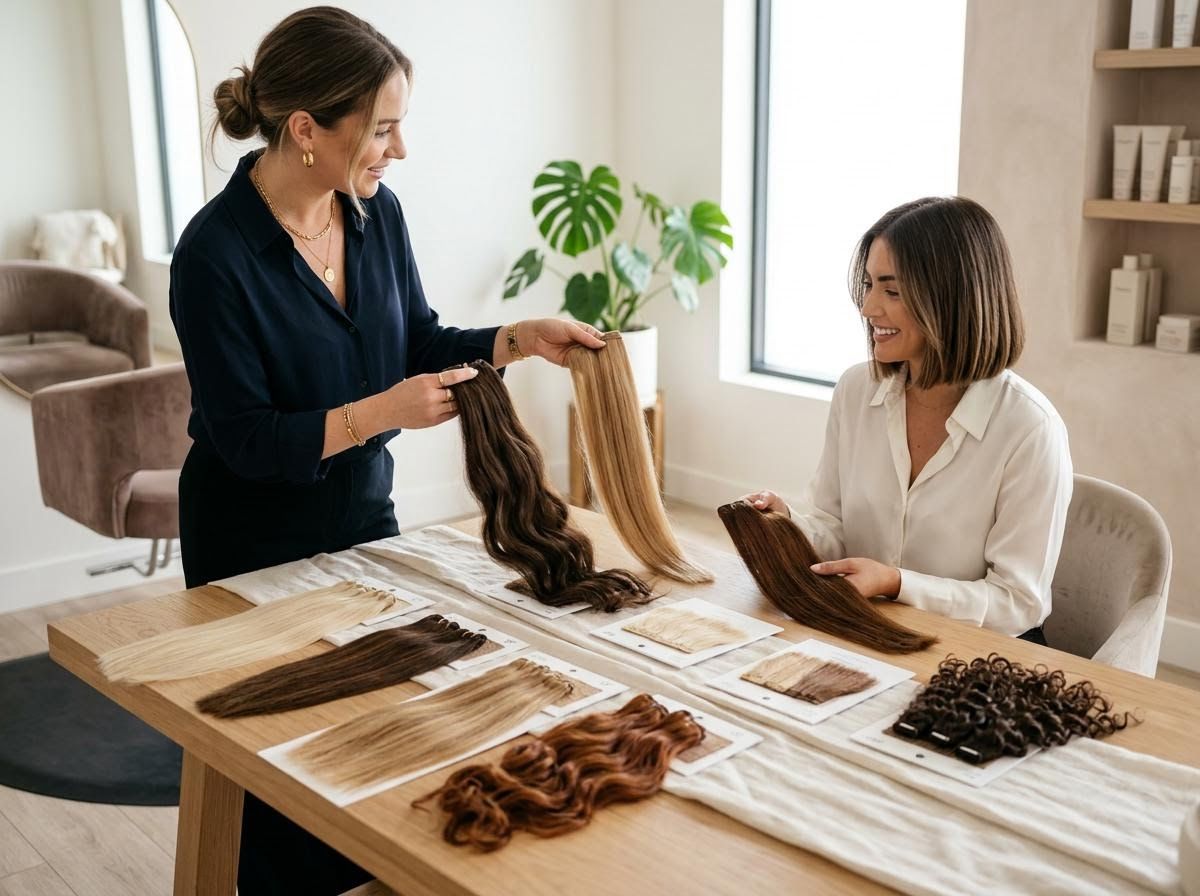
Hair extensions can add volume, improve fullness through the ends, and make fine hair easier to style. However, choosing extensions for thin hair requires more care than simply selecting a preferred length or color.
Some extension methods may be too heavy for hair with limited density. Others may create visible attachment points or place too much pressure on delicate strands. The best option should provide the desired result without adding more hair than the natural hair can comfortably support.
So, what extensions are best for thin hair? Lightweight tape-in extensions are often a suitable starting point because they have flat attachment points and can be customized for subtle fullness. Custom clip-in extensions may work well for occasional wear, while carefully installed hand-tied or beaded-row extensions may be appropriate for clients whose hair is fine but still has enough density and strength.
There is no single extension system that is best for every client. A professional consultation should consider your natural hair density, strand thickness, scalp health, existing breakage, lifestyle, desired result, and maintenance routine.
At BT on the Blvd, extension services are customized according to each client’s hair and goals. The salon offers tape-in, hand-tied, beaded-row, sewn-in, and custom clip-in extensions, with an in-person consultation required before installation.
Understanding Fine Hair Versus Thin Hair
Fine hair and thin hair are often treated as the same thing, but they describe different characteristics.
Fine hair refers to the diameter of each individual strand. A person may have very fine strands but still have a large amount of hair across the scalp.
Thin hair generally refers to lower density. This means there are fewer strands growing within a particular area of the scalp.
A client may have:
Fine strands with high density
Fine strands with low density
Coarse strands with low density
Hair that has become thinner because of shedding or breakage
These differences affect which extensions the hair can support. Someone with fine but dense hair may be a candidate for more extension methods than someone with fragile strands and visible areas of low density.
It is also important to separate naturally thin hair from active hair loss. Sudden shedding, bald patches, scalp irritation, a rapidly widening part, or unexplained changes in density should be assessed by a medical professional before extensions are installed.
Extensions can improve the appearance of fullness, but they cannot diagnose or treat the reason hair is becoming thinner.
These extensions use small sections of hair attached with thin, flat tabs. When positioned correctly, the tabs lie close to the scalp and can be concealed beneath the natural hair.
Tape-in extensions may be appropriate for clients who want:
Additional fullness around the sides and ends
Moderate length
Flat and discreet attachment points
A lightweight installation
Hair that remains flexible for everyday styling
BT on the BLVD describes its tape extensions as seamless and lightweight, with the option to add length, fullness, or both.
The amount of hair used is important. Installing too many pieces or selecting extensions that are considerably longer and heavier than the natural hair may create unnecessary tension.
For thin hair, a stylist may recommend a partial installation focused primarily on volume rather than a dramatic increase in length.
Custom Clip-In Extensions
Clip-in extensions are removable and may be a practical option for clients who only want additional fullness occasionally.
They can be worn for:
Weddings
Formal events
Photography sessions
Dinners and celebrations
Hairstyles that need temporary volume
Because clip-ins can be removed at the end of the day, the natural hair does not continuously carry their weight. BT on the BLVD offers custom-matched clip-ins for occasional wear, special events, and added volume without a permanent commitment.
However, clip-ins still need to be fitted and used correctly. Heavy pieces should not repeatedly be attached to the same fragile sections. Clips should also be removed gently instead of being pulled through the hair.
Clients with very sparse areas may not have enough natural hair to conceal the clips securely. In those cases, a stylist may suggest another cosmetic option.
Hand-Tied Extensions
Hand-tied extensions use wefts of hair that are attached to a foundation created with beads or another professional installation technique.
They can provide substantial volume and length, but they may not be the first recommendation for very thin or actively shedding hair.
A customized hand-tied installation may work for someone whose strands are fine but whose overall density remains strong enough to support a row. The stylist may use fewer rows, lighter wefts, or a shorter finished length.
The decision should be based on the condition of the supporting hair rather than the desired final look alone.
Beaded-Row Extensions
Beaded-row extensions use beads and sewn-in wefts to create a longer-lasting result. BT on the BLVD offers beaded-row services for clients seeking comfort, durability, and ongoing wear.
For clients with thin hair, the stylist must determine whether there is enough healthy hair to support the row. A row that is too heavy or tight may place concentrated pressure on the attachment area.
Beaded rows may be more appropriate for fine hair with reasonable density than for extremely sparse or fragile hair.
Sewn-In Extensions
Sewn-in extensions provide volume and structure by securing wefts to a beaded foundation. They may work well for clients with enough natural density, but the added hair must be carefully matched to the strength of the supporting strands.
This method may not be suitable when the hair is actively breaking, shedding, or thinning around the hairline.
A consultation at the BT on the Blvd Hair salon can help determine whether tape-ins, clip-ins, hand-tied extensions, beaded rows, or sewn-in extensions are the most appropriate choice.
Are Tape-In Extensions Always Best for Thin Hair?
Tape-ins are commonly recommended for fine hair, but they are not automatically the right choice for every client.
Their flat shape may make them easier to conceal than bulkier attachment methods. They can also be distributed throughout selected areas instead of being installed in full rows.
However, tape-ins may not be appropriate when:
The hair is extremely sparse around the crown
There is significant breakage near the roots
The client is experiencing active shedding
The scalp is irritated or inflamed
There is not enough hair to conceal the tabs
The client cannot commit to professional maintenance
Tape-ins also require careful home care. Oils, conditioners, and some styling products applied directly to the tabs may affect the adhesive. Excessive pulling while brushing can also place stress on the natural hair.
The best extension method is therefore the one that matches both the client’s hair condition and the client’s ability to maintain it properly.
Can Hair Extensions Make Thin Hair Worse?
Hair extensions do not automatically cause hair loss. However, any extension method may create problems when it is installed too tightly, is too heavy, remains in place without proper maintenance, or is attached to already fragile hair.
Repeated pulling on the hair follicles can contribute to traction alopecia. Medical references describe traction alopecia as hair loss caused by continuous or repeated tension on the hair roots. Early cases may improve when the tension is removed, while long-term traction can cause permanent follicle damage and scarring.
The American Academy of Dermatology advises that extensions should not feel painful or cause headaches. Pain may indicate that the hairstyle is too tight and should be adjusted. The organization also recommends professional installation, proper cleansing, protection of fragile hairline areas, and periodic breaks from extensions.
Potential warning signs include:
Persistent pulling or tightness
Headaches after installation
Scalp tenderness
Redness or irritation
Small broken hairs near the attachments
Increased thinning around the temples
Visible gaps or patches near extension rows
These symptoms should not be ignored. The extensions may need to be loosened, repositioned, or removed.
When Extensions May Not Be Recommended
A responsible stylist may postpone or decline an extension service when the natural hair is not currently strong enough to support it.
Extensions may not be recommended when a client has:
Sudden or unexplained hair loss
Active scalp inflammation
Significant breakage near the roots
Bald or very sparse areas
Pain or tenderness on the scalp
Hair weakened by overlapping chemical services
A medical condition affecting hair growth
In these situations, protecting the natural hair should come before adding length or density.
A stylist can assess the visible condition of the hair, but concerns about unexplained shedding or scalp health should be discussed with a dermatologist or other qualified medical professional.
How to Protect Thin Hair While Wearing Extensions
Choosing the correct method is only the beginning. Home care and timely maintenance also affect how the natural hair responds.
Follow the Recommended Maintenance Schedule
Extension attachments move farther from the scalp as the natural hair grows. Waiting too long between appointments may increase tangling, matting, or uneven weight distribution.
BT on the BLVD states that extension move-ups, reinstallations, and adjustments are generally needed every six to ten weeks, depending on the method and the client’s hair growth.
Brush Without Pulling
Use a brush recommended by the stylist. Hold the hair near the attachment points with one hand and begin brushing gently from the ends.
Gradually move upward instead of dragging the brush from the roots to the ends.
Keep the Scalp Clean
Wash the scalp as often as recommended for your hair type. Product buildup, oil, and residue can make extension care more difficult.
Avoid aggressive scrubbing or twisting the hair into a pile while shampooing.
Apply Conditioner Carefully
Conditioner can help reduce dryness and tangling, but it may cause certain attachment methods to loosen when applied directly to tapes, beads, or bonds.
Apply it mainly through the mid-lengths and ends unless the stylist provides different instructions.
Avoid Sleeping With Wet Hair
Hair is more vulnerable to tangling and stretching when wet. Dry the hair thoroughly before bed and place it in a loose braid or low ponytail to reduce friction.
Limit Tight Hairstyles
Avoid repeatedly pulling extensions into tight buns, high ponytails, or styles that place pressure on the hairline.
Loose hairstyles can help reduce additional tension.
Use Heat Protection
Apply a heat-protective product before blow-drying, curling, or straightening. Keep excessive heat away from the attachment areas.
Clients can also explore products selected by a Luxury hair salon in Sarasota for cleansing, conditioning, styling, and maintaining professionally treated hair.
What Happens During an Extension Consultation?
A thorough extension consultation should cover more than color matching.
The stylist should evaluate:
Natural hair density
Individual strand thickness
Existing breakage
Hairline strength
Scalp condition
Current haircut
Chemical and color history
Desired length and fullness
Daily styling habits
Budget for installation and maintenance
The stylist may recommend adding volume without adding considerable length. This approach can be especially helpful for someone whose ends appear thin or uneven.
Clients should also ask:
Which extension method will place the least tension on my hair?
How many tapes, pieces, or rows will I need?
How long can the finished extensions safely be?
How frequently will I need maintenance?
Which products should I avoid?
Can I continue coloring or lightening my hair?
What should I do if an attachment feels uncomfortable?
What will the initial and ongoing cost be?
At BT on the BLVD, final extension pricing depends on the method, length, density, number of rows or tapes, color customization, desired fullness, and maintenance plan.
Frequently Asked Questions About Extensions for Thin HairWhat extensions are best for very thin hair?
A lightweight tape-in installation or a small custom clip-in set may be considered first. However, extremely sparse or actively shedding hair may not be strong enough for extensions.
Are tape-in extensions visible in thin hair?
They may be visible when placed too close to the part, crown, or hairline. Proper placement, smaller sections, accurate color matching, and the right number of tabs can help conceal them.
Are clip-ins better for thin hair?
Clip-ins may be useful for occasional volume because they can be removed after use. They should still be lightweight and placed carefully to avoid repeated pulling on the same strands.
Can thin hair support hand-tied extensions?
Some fine-haired clients can wear hand-tied extensions when they have adequate density and healthy supporting hair. Clients with very low density or active breakage may need a lighter method.
How long should extensions be for thin hair?
The recommended length depends on the strength and current length of the natural hair. A moderate increase in length is usually easier to support than an extremely long, heavy installation.
How many extensions does thin hair need?
There is no standard number. A client seeking volume may require fewer pieces than someone requesting both length and fullness. The goal should be to use only the amount needed for a balanced result.
What is the best hair care routine for thin hair with extensions?
A suitable routine includes gentle cleansing, careful brushing, conditioner through the ends, limited tension, heat protection, drying hair before sleeping, and professional maintenance at the recommended intervals.
Find the Right Extensions for Your Natural Hair
For many clients, lightweight tape-ins are a practical answer to the question, “What extensions are best for thin hair?” Custom clip-ins can provide occasional fullness, while hand-tied, beaded-row, or sewn-in methods may work when the natural hair has enough density and strength.
The right choice depends on the health of the hair, the weight of the extensions, the placement of the attachments, the desired length, and the client’s maintenance routine.
BT on the BLVD provides personalized extension consultations for clients in Sarasota, Lakewood Ranch, Manatee County, and nearby areas. Visit www.btontheblvd.com to explore the salon’s services and schedule a consultation for an extension plan designed around your natural hair.